Platforms and the OSAL
A Termina program never calls an operating system directly. The C code that the transpiler emits is written against a fixed interface, the Termina Operating System Abstraction Layer (OSAL), and each supported platform provides an implementation of that interface on top of its own operating system and toolchain. This chapter describes the resulting execution stack, the services the OSAL provides, and the platforms that are currently supported.
The execution stack
From source to hardware, a deployed application has four layers:
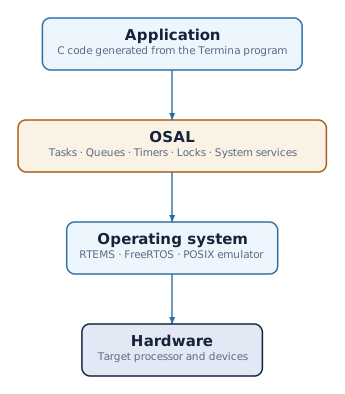
The generated code is the same for every platform; only the layers beneath it
change. All the primitives that the reactive model relies on reach the
operating system through OSAL functions: the thread and message queue behind
each task, the timers behind the periodic emitters, the locks behind resource
protection, and the atomic operations behind the atomic types. The transpiler
emits calls such as termina__msg_queue__recv or
termina__resource__lock, and the OSAL maps them onto the corresponding
RTEMS directives, FreeRTOS API calls, or POSIX functions.
Because nothing in the generated code names the operating system underneath,
the same application that will eventually run on a flight computer can be
developed and functionally tested on a desktop under the posix-gcc
platform.
System services and system_entry
Beyond the primitives that the generated code uses internally, the OSAL
offers a set of services that application code can call explicitly. They are
exposed through the built-in SystemAPI interface, implemented by the
runtime-provided system_entry resource that the installation and
hello-world chapters introduced. Its procedures fall into three groups:
- Time.
clock_get_uptimereturns the elapsed time since boot as aTimeVal, anddelay_insuspends the caller for a given interval. - Console output.
printandprintlnwrite a character array;print_charwrites a single character; and a family ofprint_<type>/println_<type>procedures covers every integer type, with aSysPrintBaseargument selecting decimal or hexadecimal notation, as well asf32andf64. - Console input.
readfills a character array with the bytes available on the standard input and reports how many were read.
The time procedures exist on every platform. The console procedures exist on
posix-gcc only, where they use the host terminal; the SystemAPI interface
of the embedded platforms does not include them, so a call to one of them is
rejected when a project that targets those platforms is type checked. The
system_entry resource is deployed only when enable-system-port is set in
termina.yaml, as described in the chapter on the application module.
Supported platforms
Termina currently supports four platforms:
| Platform | Operating system | Target | Toolchain |
|---|---|---|---|
posix-gcc |
POSIX emulator | Linux or macOS host | host gcc |
rtems5-leon3sf-nexysa7 |
RTEMS 5 | LEON3 (SPARC V8), soft-float | sparc-gaisler-rtems5-gcc (Gaisler RCC) |
rtems6-zynq7000-pynqz2 |
RTEMS 6 | Zynq-7000 (Arm Cortex-A9) | arm-rtems6-gcc (RTEMS Source Builder) |
freertos10-stm32l432-nucleol432kc |
FreeRTOS 10 | STM32L432 (Arm Cortex-M4) | arm-none-eabi-gcc |
The posix-gcc platform runs Termina applications on a conventional
Unix-like host, which makes it the usual choice for prototyping and
functional validation. Its OSAL does not simply map tasks onto host threads:
it implements a single-core, fixed-priority preemptive scheduler of its own on
top of POSIX: each task is a pthread, but the OSAL keeps per-priority ready queues and suspends and
resumes the threads explicitly, so that at any instant exactly one task runs,
chosen by the same policy an RTOS would apply. Interrupts are emulated with
POSIX signals, and a timer signal drives the system tick. The keyboard
interrupt of the demos is raised by an auxiliary thread that watches the
standard input and signals the process; the signal handler then runs with
scheduling suspended, as an interrupt service routine would. The
interrupt-disabling protection that resources may require becomes the
blocking of those signals. The emulation preserves the scheduling logic of
the reactive model, including preemption and priority order, but not its
timing: the host decides when the process runs, so posix-gcc validates
functionality and sequencing, not deadlines.
The rtems5-leon3sf-nexysa7 platform targets the LEON3, a SPARC V8 processor
widely used in European space missions, running RTEMS 5 on the Digilent
Nexys A7 development board. The processor of that board has no floating-point
unit, so the platform compiles for soft-float; the sf in its name comes from
the Gaisler board support package it uses, leon3_sf. The
rtems6-zynq7000-pynqz2 platform targets the Zynq-7000, a system-on-chip with two Arm Cortex-A9 cores, running RTEMS 6 on
the PYNQ-Z2 board; RTEMS is built there in its single-processor configuration,
so the application runs on one of the two cores. The
freertos10-stm32l432-nucleol432kc platform targets the STM32L432
microcontroller running FreeRTOS 10 on the NUCLEO-L432KC board, representative
of the small Arm-based controllers found in instrumentation and robotics. On
the embedded platforms the build produces an image to be loaded on the board,
and tasks are scheduled by the RTOS with the priorities declared in the
application module.
The platform is selected per project, in termina.yaml, and the chapter on
the build system describes how the generated Makefile invokes the
corresponding toolchain. The Docker image distributed by the project bundles
the toolchains of the four platforms, so switching among them does not
require installing anything.
Versioning and compatibility
The transpiler and the OSAL are released in lockstep at the MAJOR.MINOR
level: a transpiler vA.B.x is compatible with any OSAL vA.B.y, and a
release that changes the contract between the generated code and the layer
beneath it bumps the minor version of both. The patch level moves
independently on each side. When the toolchain is installed from source, the
two repositories must therefore be checked out at the same major and minor
version, as the installation chapter explains; the Docker image always
bundles a compatible pair.
Porting to a new platform
Support for a new operating system or board consists of an implementation of
the OSAL interface for it, and does not require changes to the transpiler. The
termina-osal repository
organizes the code as a portable core plus one directory per operating system
and per platform, so a port supplies the operating-system bindings and the
platform definition. The porting interface
is documented in that repository.